
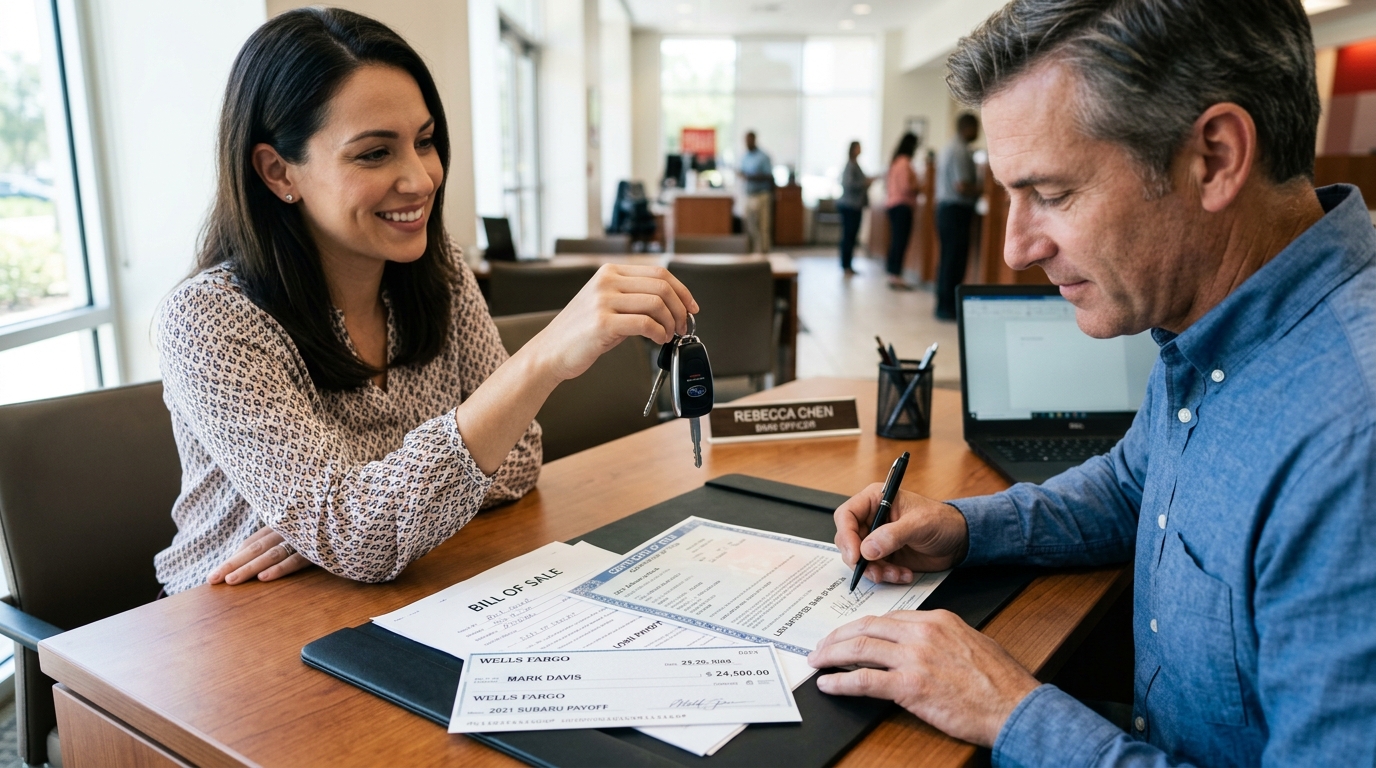
Finding a great deal on a used car only to hear the seller say, "I still have a loan on it, so the bank has the title," stops many buyers in their tracks. It is one of the most stressful situations in private car sales. Handing over thousands of dollars in cash while trusting a stranger to pay off their loan and mail you the pink slip is a recipe for disaster.
Quick answer
Never hand cash directly to a private seller who has an active auto loan. Instead, complete the transaction inside the seller's physical lending bank branch or use an automotive escrow service. Obtain an official 10-day payoff letter from the lender, make payment directly to the bank for the loan balance, pay the seller any remaining equity, and have the lender confirm that the cleared vehicle title or lien release document will be delivered directly to you or your state DMV.
What Exactly Is a Vehicle Lien?
When someone finances or leases a vehicle, the lending financial institution (bank, credit union, or captive finance company like Toyota Financial or Ford Credit) places a legal claim called a lien on the vehicle.
In title-holding states (such as California, Florida, and New York), the lender holds the physical or electronic certificate of title until the balance is paid to zero. In non-title holding states (like Ohio or Wisconsin), the owner holds the physical paper title, but the lender is stamped directly on the document as the "Primary Lienholder."
Until that lien is formally satisfied and discharged with a signed Lien Release Form, the state DMV will legally reject any attempt by a new buyer to transfer registration or obtain a clean title.
The Math: Positive Equity vs Negative Equity
Before you negotiate, you need to understand where the seller stands financially. There are two distinct scenarios:
| Scenario | Example Numbers | How the Money Moves |
|---|---|---|
| Positive Equity (Purchase Price > Loan Balance) | Sale price: $18,000 Bank payoff: $14,000 Seller equity: $4,000 | You pay $14,000 directly to the bank via cashier's check to clear the loan, and pay the remaining $4,000 to the seller. |
| Negative Equity (Purchase Price < Loan Balance) | Sale price: $15,000 Bank payoff: $18,500 Seller deficit: $3,500 | The seller must provide their own $3,500 cash to the bank at the closing table alongside your $15,000 to reach the full $18,500 payoff. |
Notice the huge danger in negative equity (commonly known as being "underwater" on the loan). If the seller does not have the liquid cash on hand to bridge that $3,500 difference, the bank will not release the lien, and the entire sale cannot legally complete.
Three Safe Ways to Close a Deal with a Lien
Here are the only three legitimate methods to purchase a vehicle when a bank holds the title:
Method 1: Close at the Seller's Local Bank Branch (The Gold Standard)
This is the cleanest and safest method. If the seller financed through a national bank (like Chase, Bank of America, or Wells Fargo) or a local credit union with physical branches nearby:
- Call ahead with the seller and schedule an appointment with a loan officer.
- Meet together at the bank branch with the vehicle.
- The loan officer pulls up the exact 10-day payoff figure on their system.
- You hand your cashier's check or wire transfer directly to the banker to satisfy the loan.
- The seller pays any remaining deficit or receives their equity check.
- The bank officer immediately notarizes a Lien Release and submits the electronic title release to the state DMV, or signs over the title if stored in-branch.
Method 2: Use an Automotive Escrow Service
If the lender is an online-only entity (such as Ally Financial, Capital One Auto Finance, or Carvana Bridgecrest) with no local brick-and-mortar locations:
Do not wire money directly to the seller's personal account. Use a licensed automotive escrow platform (such as KeySavvy or PrivateAuto). The escrow service verifies the seller's identity, pulls the official payoff statement from the lender, collects your purchase funds into a bonded escrow account, pays off the lender directly, and guarantees title transfer to you before releasing funds to the seller.
Method 3: Finance Through Your Own Bank or Credit Union
If you plan to finance a portion of the purchase, your own bank will take over the coordination. Your lender will contact the seller's lender directly, request the official payoff paperwork, wire the payoff amount, and instruct the seller's lender to mail the title directly to your bank's titling department. You never have to worry about cash handling.
Crucial Red Flags That Signal Danger
Walk away immediately if a seller presents any of the following excuses:
- "Just pay me cash and I will pay off the bank tomorrow:" Once the seller walks away with your cash, you have zero leverage. If they spend that money on personal expenses instead of paying off the loan, the bank will repossess the car right out of your driveway, and you will have no legal title.
- "Keep driving on my plates until the title comes:" This is illegal in most states and exposes both parties to severe liability if an accident occurs.
- The seller cannot produce an official 10-day payoff quote: A legitimate seller can log into their bank portal or call customer service in five minutes to generate an official payoff document with a per-diem interest calculation.
Analyze Any Listing in Seconds
Paste a Facebook Marketplace or dealer link. Avturo flags hidden issues and suggests what to ask.
Try Avturo FreeWord-for-Word Script to Use with the Seller
When you find a vehicle you like and the seller mentions an existing loan, use this message script to set clear, professional boundaries:
A genuine seller who is simply paying off their car will readily agree. An untrustworthy seller or curbstoner trying to pocket quick cash without clearing debt will make excuses and back out.
Budgeting for Post-Purchase Reliability
Cars sold with active loans are frequently 2 to 6 years old, the exact timeframe when factory 3-year/36,000-mile bumper-to-bumper warranties expire. Always verify upcoming scheduled maintenance before committing:
| Model | Typical years | Avturo cost-to-own (maint. + repairs / yr) |
|---|---|---|
| Honda Accord | midsize sedan | $700 to $1,100 |
| Toyota RAV4 | compact SUV | $700 to $1,100 |
| Ford F-150 | full-size pickup | $1,100 to $1,600 |
| Hyundai Tucson | compact crossover | $700 to $1,100 |
Figures are Avturo's model-specific estimates for scheduled maintenance plus likely out-of-warranty repairs only. They exclude insurance, fuel, financing, and depreciation, which vary too much per driver to be useful. Ranges are anchored to Edmunds True Cost to Own and RepairPal data, then adjusted for a high-mileage budget example (about 60,000 miles). Your real number depends on the individual car's service history, which is exactly what Avturo checks when you run a listing.
Summary
Buying a car with an active lien is completely safe when you follow the golden rule: payment flows directly to the legal lienholder, never into the seller's personal bank account. Always verify the exact payoff balance with an official 10-day payoff letter, close at the bank branch or via verified automotive escrow, and secure a signed Bill of Sale and Lien Release before driving away.