
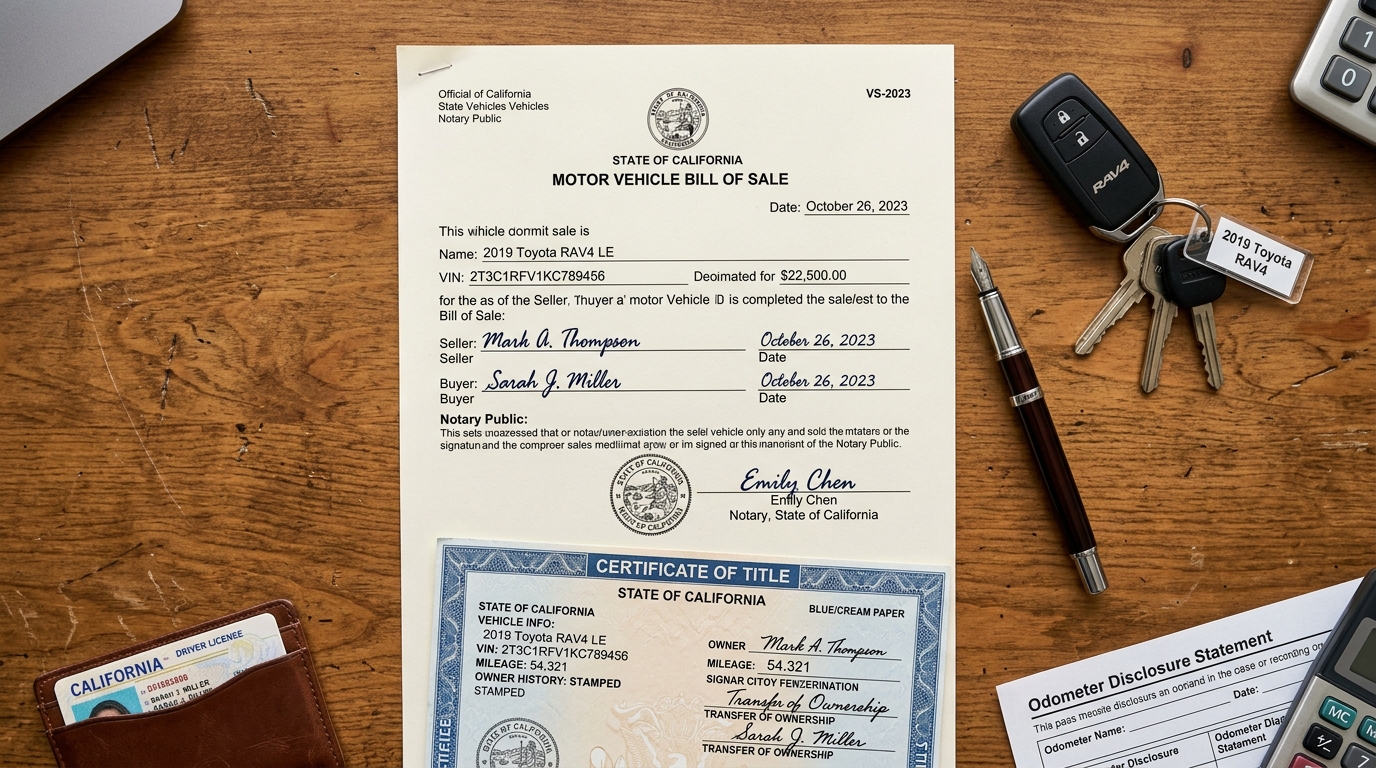
When you buy or sell a used vehicle in a private party transaction, the certificate of title transfers legal ownership, but the Bill of Sale is the legal contract that defines the financial terms, protects you against post-sale liabilities, and establishes your tax obligations at the DMV. A sloppy or incomplete bill of sale can leave sellers liable for hit-and-run accidents and leave buyers stranded at the DMV counter without legal registration.
Quick answer
A legally enforceable used car bill of sale must include: full legal names and physical addresses of both parties, the complete 17-character VIN, exact sale date and time, agreed purchase price, exact odometer reading with federal disclosure, and an explicit "As-Is, No Warranty" clause. Certain states (including Louisiana, Maryland, Montana, and West Virginia) legally mandate that the bill of sale be notarized before the DMV will accept a title transfer.
Title vs Bill of Sale: Why You Need Both
Many first-time buyers ask: "If the seller signs the back of the physical title, why do we need to fill out a bill of sale?"
The two documents serve fundamentally different legal functions:
- Certificate of Title: A state government issued document showing who holds registered title ownership of the motor vehicle.
- Bill of Sale: A binding contract of purchase and sale between two private parties. It provides a formal receipt of monetary consideration, records the exact timestamp of delivery, establishes sales tax basis, and legally disclaims implied warranties.
7 Elements Every Bill of Sale Must Contain
To avoid rejection at your local county tax assessor or DMV office, ensure your bill of sale includes these seven non-negotiable data blocks:
| Section | Required Details | Why the DMV Checks It |
|---|---|---|
| 1. Vehicle Identification | Year, Make, Model, Body Style, Color, and full 17-character VIN. | Ensures the contract links to the exact physical chassis, preventing typographical mismatch rejections. |
| 2. Legal Parties | Full legal names, physical residential addresses, driver's license numbers, and phone numbers. | Verifies identity and prevents curbstoning by establishing residency of both parties. |
| 3. Financial Consideration | The total agreed sale price written in numbers ($15,000) and spelled out in words (Fifteen Thousand Dollars). | Prevents post-sale price alterations and determines the exact state and local sales tax assessment. |
| 4. Odometer Disclosure | Exact 5 or 6 digit mileage, certifying whether it represents actual mileage, exceeds mechanical limits, or is not actual mileage. | Mandatory compliance with the Federal Truth in Mileage Act for all motor vehicles under 20 model years old. |
| 5. Exact Date and Timestamp | Date and exact time of vehicle delivery (e.g. October 2, 2026 at 2:45 PM). | Establishes the exact minute legal liability transfers, protecting the seller from bridge tolls and speed cameras. |
| 6. "As-Is" Legal Clause | Clear, conspicuous statement disclaiming all express and implied warranties. | Protects the seller from post-sale civil lawsuits if a mechanical breakdown occurs down the road. |
| 7. Signatures | Original signatures and printed names of both the buyer and seller. | Executes the document as a legally binding bilateral contract. |
The Essential "As-Is" Legal Language
In private sales, vehicles are sold without warranty. However, simply writing the words "sold as is" in small print can leave a seller exposed to claims of implied warranty of merchantability.
To ensure complete legal protection, use this explicit standard clause:
AS-IS DISCLAIMER CLAUSE:
"The Buyer acknowledges that they have thoroughly inspected the Vehicle and agree to purchase the Vehicle in its current condition, 'AS-IS, WHERE-IS,' with all faults and defects, known and unknown. The Seller makes no warranties, express or implied, including but not limited to any implied warranty of merchantability or fitness for a particular purpose. All future repair and maintenance costs are the sole responsibility of the Buyer from the time of sale."
States That Require a Notarized Bill of Sale
While most states allow private buyers and sellers to sign a bill of sale without a third party, several states strictly require a licensed Notary Public to witness signatures before the DMV will accept title transfer:
- Louisiana: Requires notarization on both the Certificate of Title and the Bill of Sale.
- Maryland: Requires a notarized bill of sale if the vehicle is less than 7 years old and the purchase price is lower than book value.
- Montana: Requires the seller's signature on the bill of sale to be notarized.
- West Virginia: Requires notarization on the bill of sale if the sale price is below the state DMV tax threshold.
- Nebraska & New Hampshire: Highly recommended or required in specific county clerk jurisdictions.
Meeting at a local bank branch, UPS Store, or AAA office is the easiest way to find an on-site notary public and complete the transaction securely.
Analyze Any Listing in Seconds
Paste a Facebook Marketplace or dealer link. Avturo flags hidden issues and suggests what to ask.
Try Avturo FreeState-Specific Official DMV Bill of Sale Forms
Many states publish their own official, standardized bill of sale documents. While a generic written contract is often acceptable, using the state's official form guarantees fast, friction-free processing at the counter:
- California: Form REG 135 (Bill of Sale) and Form REG 262 (Vehicle/Vessel Transfer and Reassignment).
- Texas: Form 130-U (Application for Texas Title and/or Registration) and Form VTR-346 (Texas Motor Vehicle Transfer Notification).
- Florida: Form HSMV 82050 (Notice of Sale and/or Bill of Sale).
- New York: Form MV-912 (Vehicle Bill of Sale).
Budgeting for Post-Purchase Expenses
Once the bill of sale is signed, factor in upcoming maintenance milestones for common reliable private-sale vehicles:
| Model | Typical years | Avturo cost-to-own (maint. + repairs / yr) |
|---|---|---|
| Toyota Corolla | compact sedan | $600 to $900 |
| Honda CR-V | compact crossover | $700 to $1,100 |
| Subaru Outback | all-wheel-drive wagon | $900 to $1,400 |
| Ford F-150 | light truck | $1,100 to $1,600 |
Figures are Avturo's model-specific estimates for scheduled maintenance plus likely out-of-warranty repairs only. They exclude insurance, fuel, financing, and depreciation, which vary too much per driver to be useful. Ranges are anchored to Edmunds True Cost to Own and RepairPal data, then adjusted for a high-mileage budget example (about 80,000 miles). Your real number depends on the individual car's service history, which is exactly what Avturo checks when you run a listing.
Crucial for Sellers: The Notice of Transfer
If you are the seller, signing the bill of sale is only half the battle. You must immediately file a Notice of Transfer and Release of Liability with your state DMV (e.g. California REG 138, Texas VTR-346, or Florida HSMV 82050).
Until you file this notice, the state still recognizes you as the registered owner. If the buyer never registers the car, runs red lights, skips bridge tolls, or abandons the vehicle on the highway, municipal impound lots and toll authorities will send thousands of dollars in collection notices directly to your mailbox. Filing the notice of transfer within 5 days legally severs your civil liability.
Summary
A complete, well-drafted bill of sale is essential for any private vehicle transaction. Ensure all vehicle details, exact timestamps, accurate odometer disclosures, and explicit as-is legal disclaimers are written clearly. Print two copies so both buyer and seller retain an original signed record for tax and liability protection.