
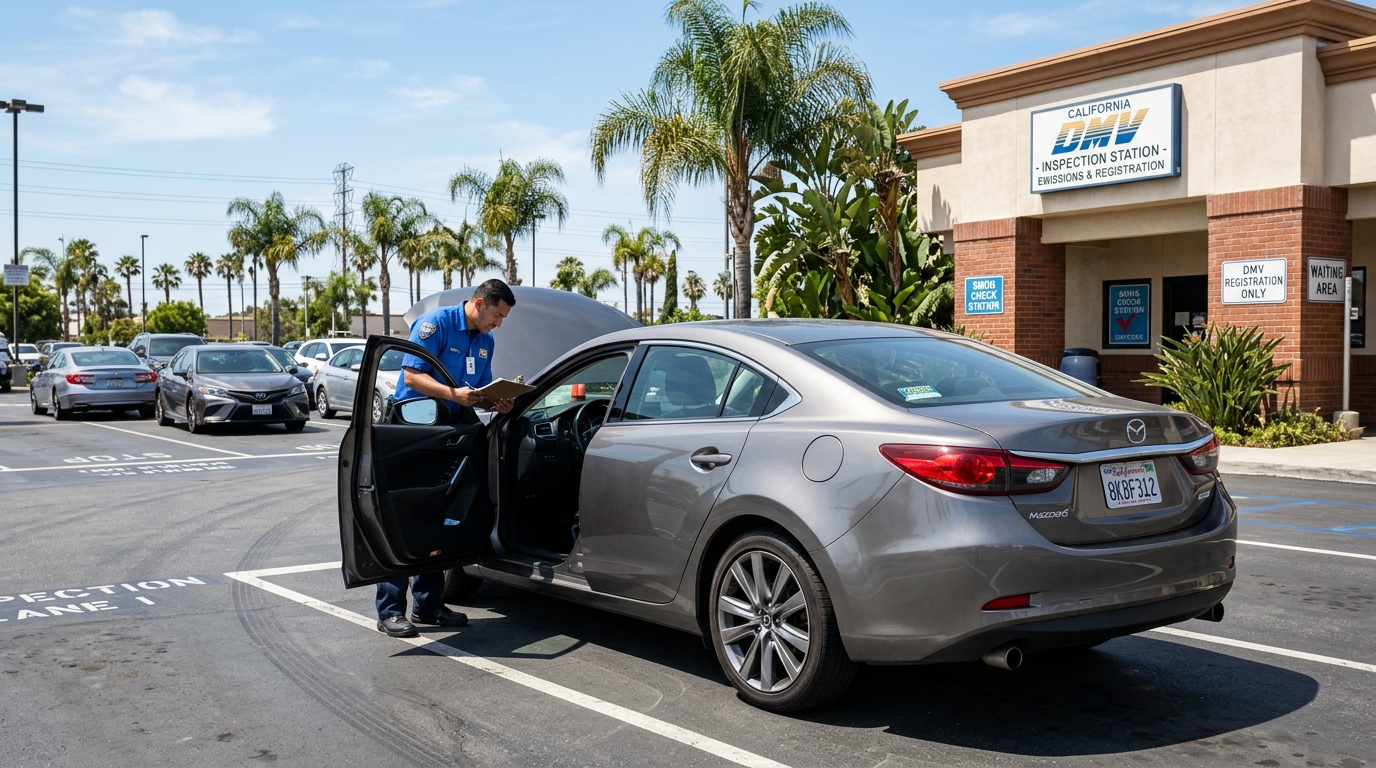
Buying a used car in California involves stricter emissions regulations, higher registration fees, and unique consumer protection statutes compared to almost any other state. If you do not know the exact rules, you can easily end up holding the keys to a vehicle you legally cannot register or drive.
Quick answer
In California, state law (California Vehicle Code §24007) requires the seller to provide an official smog certificate dated within 90 days of the sale for private party transactions. As a buyer, you must transfer the title at the California DMV within 10 days and pay California use tax (7.25% state base plus local district taxes, reaching up to 10.75%). If buying from a licensed dealer, you have the legal right under the California Car Buyer’s Bill of Rights to purchase a 2-day contract cancellation option on vehicles priced under $40,000.
The 90-Day Smog Rule: California’s Biggest Trap
The number one financial trap for used car buyers in California is purchasing a car that cannot pass a smog test. Under California Vehicle Code Section 24007(b)(2), the seller is legally responsible for providing a valid smog inspection certification before delivering the vehicle.
Private sellers frequently try to dodge this responsibility by writing "buyer handles smog" or "sold as-is, needs smog" on the bill of sale. Under California law, this agreement is legally void. A private seller cannot contract out of their statutory obligation to provide smog certification. If a car cannot pass smog in California, the DMV will issue a temporary operating permit at best, but will refuse full registration and title issuance until it passes.
Exemptions to the smog certification requirement exist only for specific cases:
- Gasoline-powered vehicles 8 model years old or newer (the buyer pays an annual smog abatement fee instead).
- Historic vehicles manufactured in 1975 or earlier.
- Dedicated electric vehicles.
- Transfers between direct qualifying family members (spouse, domestic partner, parent, grandparent, child, grandchild, or sibling).
Always check the certificate verification online at the California Bureau of Automotive Repair (BAR) portal before handing over cash. You can enter the car's VIN or license plate number to view its full smog test history, including historical failures and abort codes.
Calculating California DMV Fees and Sales Tax
When you budget for a used car in California, the sticker price is never your final cost. The California DMV collects several fees simultaneously when you submit the transfer:
| Fee Component | Rate / Amount | How It Is Determined |
|---|---|---|
| California Use Tax | 7.25% to 10.75% | Based on your residential registered address, calculated on the vehicle purchase price. |
| Vehicle License Fee (VLF) | 0.65% of market value | State property tax assessed on the vehicle valuation, depreciated over an 11-year schedule. |
| Registration Fee | $70 base | Base California DMV annual registration charge. |
| California Highway Patrol (CHP) Fee | $32 | Mandatory state law enforcement support assessment. |
| Transportation Improvement Fee (TIF) | $30 to $205+ | Graduated fee scale based on vehicle value tiers under SB 1. |
| County / Air Quality District Fees | $10 to $35 | Local county air district clean air and abandoned vehicle abatement surcharges. |
| Transfer Fee | $15 | Flat processing fee for transferring registered ownership. |
On a $20,000 used car purchased in Los Angeles County (where the combined sales and district tax rate is 9.5%), you will owe roughly $1,900 in use tax alone, plus another $350 to $450 in VLF, CHP, and registration fees. Always factor an extra 10% to 12% on top of the negotiated price for state fees.
Long-Term Maintenance Benchmarks in California
Operating costs in California run higher than national averages due to premium gas prices, tire wear on grooved freeways, and higher automotive technician shop labor rates ($175 to $250 per hour in major metro areas like San Francisco, San Jose, and Los Angeles).
| Model | Typical years | Avturo cost-to-own (maint. + repairs / yr) |
|---|---|---|
| Toyota Camry | midsize sedan | $700 to $1,100 |
| Honda CR-V | compact crossover | $700 to $1,100 |
| Subaru Outback | all-wheel-drive wagon | $900 to $1,400 |
| BMW 3 Series | compact luxury | $1,700 to $2,500 |
Figures are Avturo's model-specific estimates for scheduled maintenance plus likely out-of-warranty repairs only. They exclude insurance, fuel, financing, and depreciation, which vary too much per driver to be useful. Ranges are anchored to Edmunds True Cost to Own and RepairPal data, then adjusted for a high-mileage budget example (about 75,000 miles). Your real number depends on the individual car's service history, which is exactly what Avturo checks when you run a listing.
The California Car Buyer’s Bill of Rights
California has one of the most comprehensive automotive consumer protection statutes in the United States. Under California Civil Code §2982, every licensed car dealer selling a used vehicle priced under $40,000 must offer the buyer a written 2-Day Contract Cancellation Option Agreement.
Here is how the 2-day return option functions:
- Right to Purchase: The dealer must present this option contract before you sign the purchase agreement. You have the right to accept or decline.
- Maximum Fee: The dealer can charge a regulated non-refundable option fee: up to $75 for cars under $5,000, $150 for cars up to $10,000, $250 for cars up to $30,000, and $500 for cars between $30,000 and $40,000.
- Restocking Fee: If you return the vehicle within the 2-day window (by close of business on the second day following the sale), the dealer may retain a capped restocking fee ($175 to $500 depending on vehicle price), minus the option fee you already paid.
- Return Conditions: The car must be returned in the same condition as delivered, driven under 250 miles (or the higher limit agreed upon in writing), and free of any new liens or damage.
Note: The Car Buyer's Bill of Rights does not apply to private party sales, commercial transactions, or motorcycles. It also prohibits dealerships from marketing a used car as "Certified" if the vehicle has frame damage, odometer issues, or a history of salvage.
Analyze Any Listing in Seconds
Paste a Facebook Marketplace or dealer link. Avturo flags hidden issues and suggests what to ask.
Try Avturo FreeStep-by-Step Private Sale Checklist in California
If you are buying directly from a private party in California, follow these steps in exact sequence:
- Inspect the California Certificate of Title (Form REG 227 if lost): Verify the seller's name matches their government photo ID exactly. Ensure the title is not stamped with "Salvage" or "Junk" unless you knowingly want a rebuilt vehicle.
- Confirm Active Smog Certification: Demand proof of a passed smog test within the last 90 days. If the seller cannot supply a valid printout, meet them at a STAR-certified smog station and have the test completed before paying.
- Fill Out Section 1 of the Title (Transfer of Ownership): The seller must sign and print their name on line 1a. You, as the buyer, sign and date on the back of the title in the new registered owner section.
- Execute a Detailed Bill of Sale (Form REG 135): Document the purchase price, date, VIN, odometer reading, and both parties' full contact details.
- Ensure Seller Files the NRL: The seller must submit a Notice of Transfer and Release of Liability (Form REG 138) to the California DMV within 5 days. This legally releases them from parking tickets and bridge tolls incurred after the handoff.
- Complete Buyer Transfer Within 10 Days: You have 10 calendar days from the purchase date to complete the transfer at a California DMV field office or through an authorized partner like AAA. Failing to submit within 10 days triggers DMV monetary late penalties.
Specific California Red Flags to Avoid
When reviewing vehicle listings across Los Angeles, the Bay Area, San Diego, and the Central Valley, look out for these state-specific red flags:
- "Needs Cat Converter": In California, replacement catalytic converters must be CARB-compliant (California Air Resources Board executive order certified). A generic $150 49-state converter will fail the visual smog test. A legal CARB-certified catalytic converter replacement often costs $1,500 to $3,500 with parts and labor.
- Aftermarket Intakes and Tunes Without CARB E.O. Numbers: Modifications such as cold air intakes, headers, or ECU tunes will cause an automatic failure at the smog station unless accompanied by a CARB Executive Order sticker with a verifiable number.
- Unpaid Registration Back-Fees: In California, delinquent registration fees stick to the vehicle, not the prior owner. If the previous owner neglected registration for three years, the DMV will charge you every penny of back taxes and penalties upon title transfer. Always ask the seller for the current registration card or run the license plate on the DMV vehicle registration fee calculator.
Summary
California provides strong buyer protections through dealer cancellation rules and seller smog obligations, but private transactions still require careful due diligence. Never purchase a car without a fresh smog certificate, budget an additional 10% to 12% for DMV use tax and fees, and check all VIN tags against official state records before signing the title.