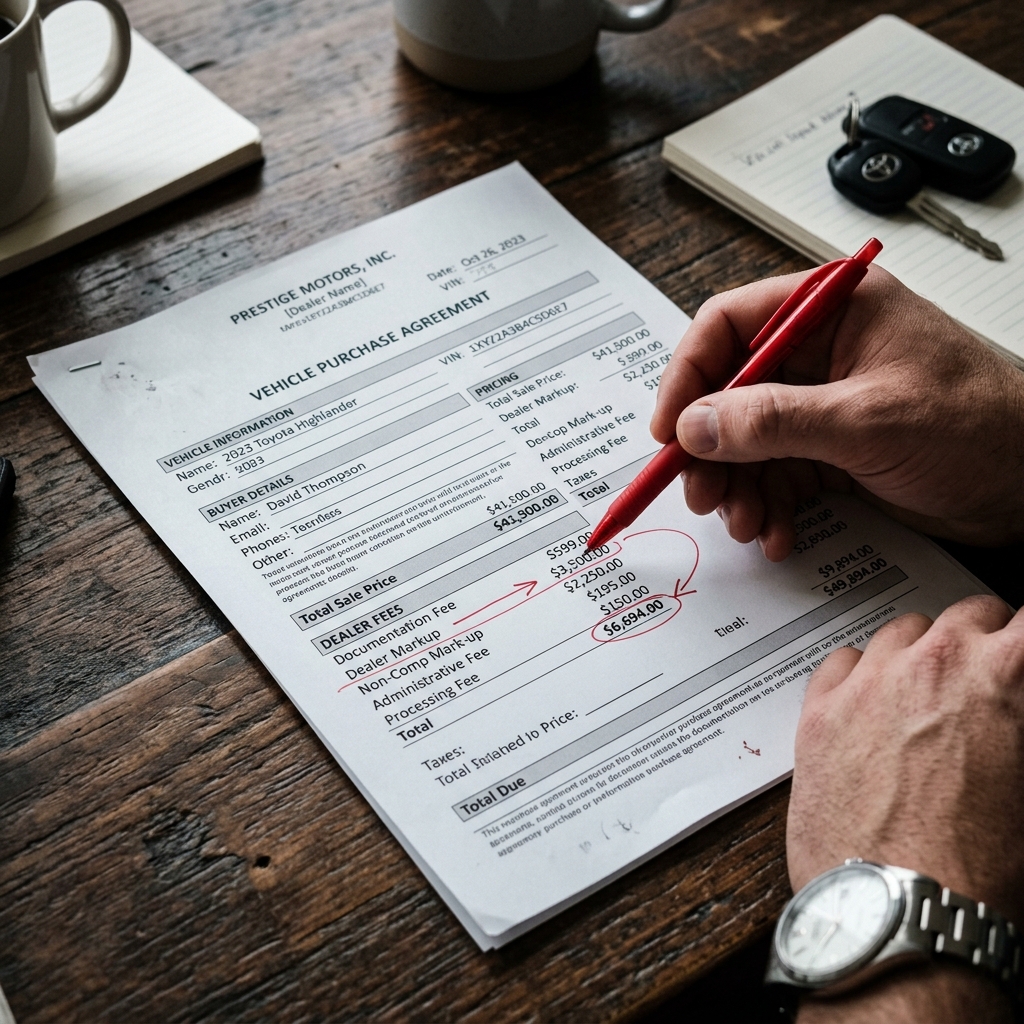
When you negotiate a car purchase, agreeing on the selling price is only half the battle. The real profit-grabbing happens in the Finance and Insurance (F&I) office, where dealers add hundreds or thousands of dollars in junk fees to the final contract.
Dealers know that after hours of test driving and negotiating, buyers are tired and eager to sign. They slip in pre-printed, official-looking fees hoping you won't question them. But as an informed buyer, you have the right to refuse them.
The Atomic Answer: What are Dealer Junk Fees?
Dealer junk fees are arbitrary charges added to a car purchase contract designed solely to pad the dealership's profit margins. While you are legally required to pay government fees (like state sales tax, title transfer, and vehicle registration), you should always refuse dealership fees like dealer prep, nitrogen inflation, electronic filing markups, and anti-theft fees.
Legitimate Fees vs. Dealer Junk Fees
Before signing your buyer's order, cross-reference all items on the contract using this quick checklist:
| Fee Name | Legitimate? | Typical Cost | Action / Negotiation Strategy |
|---|---|---|---|
| State Sales Tax | Yes | 0% in a few states (such as Montana and New Hampshire) to over 10% with local taxes in some California cities | Legally required. Usually charged on the sale price. Most states subtract your trade-in first, but California, Virginia and Hawaii give no trade-in credit, and some states (Michigan, for example) cap it. |
| Title & Registration | Yes | Varies widely by state; higher where fees are based on the car's value | Legally required state fees to register the car in your name. Verify against DMV site. |
| Documentation (Doc) Fee | Semi-Legitimate | Under $100 where capped to $1,000+ where not | Some states cap this (e.g. $85 in CA). If uncapped, negotiate a discount on the car price to offset it. |
| Dealer Prep / PDI Fee | Junk | $200 to $800 | Decline. Preparing a car for sale is a cost of doing business. On new cars, manufacturers typically compensate dealers for PDI; on used cars, reconditioning belongs in the asking price. |
| Nitrogen-Filled Tires | Junk | $100 to $400 | Decline. Regular air is already 78% nitrogen. Refuse to pay extra. Ask them to replace it with normal air. |
| Anti-Theft (VIN Etching) | Junk | $199 to $599 | Decline. Etching the VIN onto windows can be done at home for $20. Tell them to cross this off the contract. |
| Fabric & Paint Protection | Junk | $500 to $1,500 | Decline. Usually a basic spray-on sealant sold at a steep markup. Buy aftermarket ceramic sprays instead. |
Check Any Listing in About a Minute
Paste a Facebook Marketplace or dealer link. Avturo shows the red flags in the ad, the problems that model is known for, and what to ask the seller.
Try Avturo FreeThe 8 Dealership Junk Fees to Always Decline
1. Dealer Prep / Pre-Delivery Inspection (PDI)
Dealers claim this covers cleaning the car, removing protective plastics, and filling the fluids. On a new car, the manufacturer typically compensates the dealership for this work, so a separate charge means paying for it twice. On a used car, getting it ready for sale is part of what the asking price already covers.
2. Uncapped Documentation Fees
Doc fees cover the administrative cost of processing title and loan documents. States like California ($85) and New York ($175) cap doc fees. In states without a cap, such as Florida, they can run to $1,000 or more. While the fee itself is pre-printed, you should ask the dealer to discount the sales price of the vehicle by the amount of their doc fee markup.
3. Nitrogen Tire Inflation
Some dealers claim nitrogen keeps tire pressure more stable than normal air. Nitrogen does seep out of a tire a little more slowly, but on a passenger car, checking your pressure once a month with ordinary air gets you nearly the same benefit. Never pay extra for this.
4. VIN Etching / Window Security
The dealer chemically etches the vehicle's VIN onto the windows as a theft deterrent. They pre-apply this and claim it cannot be removed. You should respond: "I didn't request this service. I will not pay for it."
5. Paint & Fabric Sealants
Typically this is a fabric protector sprayed on the seats and a sealant applied to the paint, sold at a steep markup. These treatments are not factory options and are unnecessary for modern automotive finishes.
6. Advertising Fees (TDA/MACO)
The dealer may try to charge you for their regional advertising cost. This is a business expense. If it shows up as a separate line item on your buyer's order, negotiate it off.
7. Electronic Filing Markups
Dealers may charge you for registering the car online with the state. The actual state registration fee is legitimate, and a few states let dealers charge a set electronic filing fee. Anything added on top of what your state allows, such as a "convenience fee" for the filing, is profit. Ask the dealer to show you where your state permits the charge.
8. Key Replacement & Scratch Warranties
These are auxiliary service contracts added in the finance room. Unless you lose keys constantly, they are a bad deal. Decline them.
Negotiation Script: How to Stand Your Ground
When you spot a junk fee on your buyer's order, use this exact word-for-word response script:
"I want to buy this car, but I am only prepared to pay the agreed price of the vehicle, the official state taxes, and DMV registration fees. I will not pay for these additional dealer fees, like the prep charge or nitrogen inflation. Let's get these removed so we can sign the paperwork."
If the manager claims the fees are pre-printed and "everyone has to pay them," reply:
"I understand you cannot change the pre-printed fee line. If you can't remove the fee line, you can discount the vehicle sales price by the equivalent amount. Otherwise, I will have to walk away and buy elsewhere."
Check the Car and the Price Before You Sit Down
Avturo does not read contracts or buyer's orders, so go through the fee lines yourself using the table above. What it can do is check the car before you reach the F&I office: paste the dealer's listing link or ad text, or upload screenshots, into the Avturo Listing Analyzer.
Avturo compares the asking price with live asking prices of comparable listings (or gives a clearly labeled AI estimate when it can't find enough), reads the ad for red flags such as title problems or an existing loan, and lists the official NHTSA recall campaigns for the car's model year. If a fee on your paperwork confuses you, ask the buying advisor chat on your report; it searches the web and shows its sources.
Summary: Protect Your Wallet
- Request an Out-the-Door (OTD) Price early: Get the full fee breakdown in writing before you visit the F&I office.
- Look for the pre-printed labels: Just because it looks official doesn't mean it's legitimate or required.
- Be prepared to walk away: The most powerful negotiation tool is your feet. If a dealer refuses to waive thousands in junk fees, walk out.