
Following major hurricanes and regional flash flooding, insurance companies write off hundreds of thousands of vehicles submerged in muddy, contaminated water. But instead of being scrapped, tens of thousands of these ruined cars are bought by rebuilders, dried out, cosmetically detailed, and transported hundreds of miles away to be sold to unsuspecting buyers with seemingly clean titles.
Quick answer
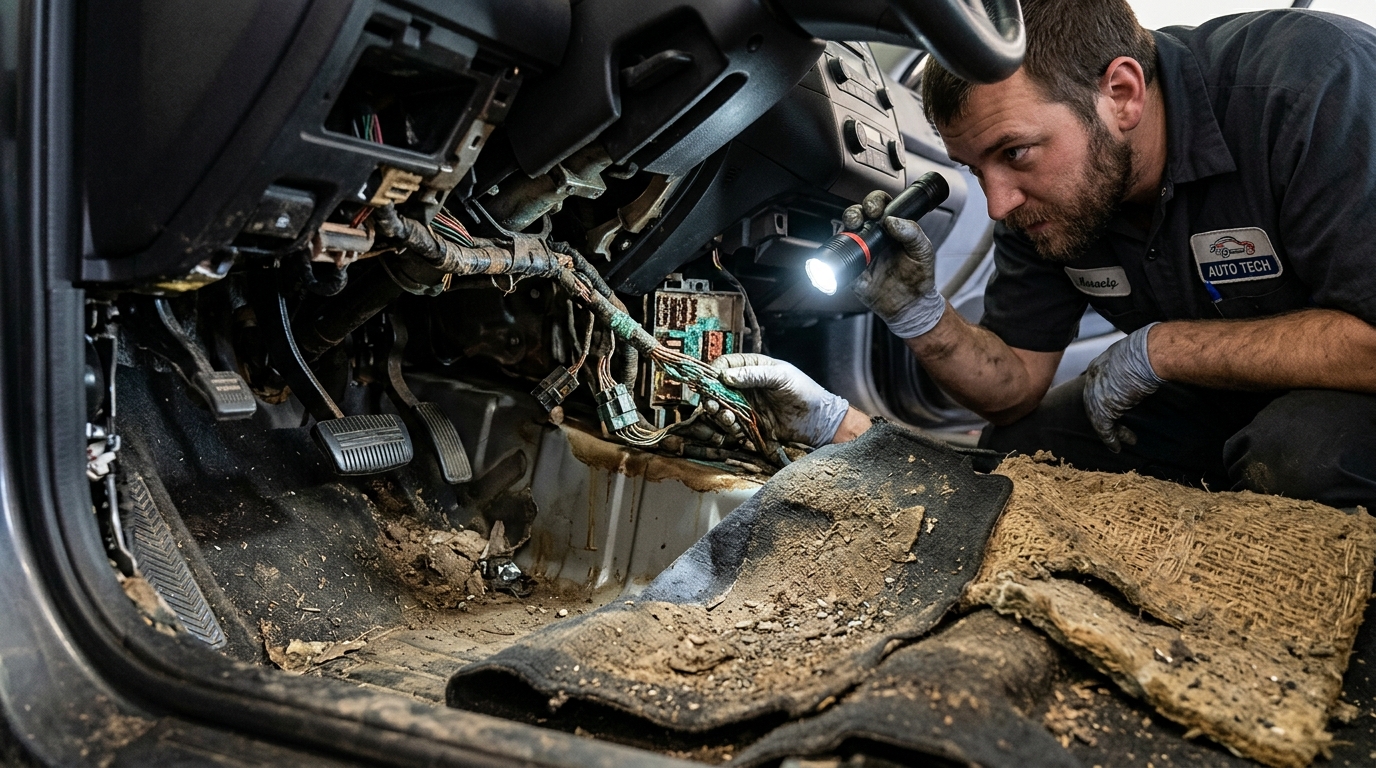
To detect a flood-damaged car, inspect the unpainted cabin areas that detailers overlook: look for fine dried silt inside the fuse box, dashboard wiring harnesses, seat rail crevices, and inside the spare tire well. Smell for mildew masked by heavy perfume or ozone treatments, check for surface rust on unpainted metal steering column brackets under the dash, and run the VIN through the National Insurance Crime Bureau (NICB) database to catch flood title brands.
Why Submerged Cars Are Financial Time Bombs
Flood damage is unlike any mechanical breakdown. When a car is submerged, water penetrates microscopic spaces in electronic modules, sensor connectors, airbags, and wiring harnesses.
Fresh water is destructive enough, but salt water or storm surge water is catastrophic. The dissolved minerals and salts act as rapid electrolytes, initiating galvanic corrosion inside wiring bundles. A flood car might start and run perfectly on the day you test drive it, only to suffer cascading electrical failures six months later:
- Airbag control modules (ACUs) short-circuit or fail to deploy in an impact.
- Anti-lock brake (ABS) sensors corrode, triggering intermittent braking failures.
- Body Control Modules (BCM) develop erratic shorts, causing headlights, wipers, and door locks to cycle randomly.
- Water trapped in wheel bearings, differential housings, and steering racks leads to premature mechanical seizure.
How Scammers "Wash" Flood Titles
When an insurance company declares a car a total loss due to water damage, the vehicle title is formally branded with "Flood" or "Salvage" in that state. So how does a flood car end up with a "Clean" title in another state?
Through an illegal practice known as title washing:
- A rebuilder purchases a flooded car at an insurance salvage auction in a hurricane state (such as Florida, Louisiana, or North Carolina).
- The vehicle is physically transported across state lines to a state with lax brand-conversion statutes or older paper title systems.
- The rebuilder applies for a replacement or bonded title in the new state before the national databases update, exploiting administrative reporting delays between state DMVs.
- The new state issues a fresh paper title without transferring the flood brand notation.
- The seller advertises the car as "clean title, one owner, garage kept" on online classifieds hundreds of miles from the original disaster zone.
7 Spots to Inspect for Hidden Flood Damage
Detailers can shampoo carpets and scrub exterior paint, but they rarely take the time to disassemble hidden interior components. Pull out a bright LED flashlight and inspect these seven critical spots:
| Inspection Spot | What You Are Looking For | Why Detailers Miss It |
|---|---|---|
| Under-Dash Steering Bracket | Flaking orange surface rust on bare steel brackets and pedal springs. | Factory interior brackets are bare unpainted steel; normal humidity never causes them to rust unless submerged. |
| Main Fuse and Relay Box | Dried powdery silt or green/white corrosion around relay blades and fuses. | Requires opening the fuse box cover and pulling individual relays. |
| Seat Rails and Mounting Bolts | Rust on seat mounting bolts, or signs the seat bolts were recently removed to dry carpets. | Bolts are deep in track crevices beneath plastic vanity covers. |
| Seat Belt Webbing (Pulled to End) | A distinct water/tide mark line or mildew staining when the belt is pulled out all the way. | Detailers wipe the visible section of seat belts, but rarely reel them out completely. |
| Spare Tire Wheel Well | Standing water, dried mud lines, or rusty jack tools beneath the trunk floorboard. | Low-point drainage grommets trap water and silt beneath the spare tire. |
| Behind Door Weatherstripping | Fine river silt or sand trapped behind the rubber door frame gaskets. | Gaskets must be peeled back by hand to reveal trapped sediment. |
| Headlight and Fog Light Lens Housings | Water condensation droplets or a cloudy waterline inside sealed light enclosures. | Sealed housings cannot be wiped from the inside without complete baking or replacement. |
The Scent Test: Mildew vs Ozone Overload
Trust your nose. Close all doors and windows and sit inside the car for two minutes. Does it smell like damp basement, sour laundry, or mold?
Conversely, be extremely suspicious if the car interior has an overpowering chemical smell or artificial vanilla scent. Sellers frequently run industrial ozone generators or empty multiple cans of disinfectant into the AC vents to mask decaying carpet jute padding. If a 7-year-old car smells intensely like chemical air fresheners, ask yourself what the seller is trying to hide.
Analyze Any Listing in Seconds
Paste a Facebook Marketplace or dealer link. Avturo flags hidden issues and suggests what to ask.
Try Avturo FreeMaintenance Costs on Weather-Stressed Vehicles
Vehicles that have been exposed to extreme moisture, standing water, or heavy northern road salt incur substantially higher suspension, brake line, and electrical repair costs:
| Model | Typical years | Avturo cost-to-own (maint. + repairs / yr) |
|---|---|---|
| Ford Explorer | midsize 3-row SUV | $1,000 to $1,500 |
| Jeep Wrangler | compact off-road SUV | $1,000 to $1,400 |
| Ram 1500 | full-size pickup | $1,100 to $1,600 |
| Nissan Altima | midsize sedan | $700 to $1,200 |
Figures are Avturo's model-specific estimates for scheduled maintenance plus likely out-of-warranty repairs only. They exclude insurance, fuel, financing, and depreciation, which vary too much per driver to be useful. Ranges are anchored to Edmunds True Cost to Own and RepairPal data, then adjusted for a high-mileage budget example (about 75,000 miles). Your real number depends on the individual car's service history, which is exactly what Avturo checks when you run a listing.
Free Digital Databases to Check for Flood Records
Before you meet the seller, run the vehicle VIN through these two free authoritative databases:
- NICB VINCheck: The National Insurance Crime Bureau operates a free online lookup tool that searches member insurance company total-loss salvage and flood declarations.
- Avturo Listing Analyzer: Avturo checks the VIN against federal NHTSA recall records, title brand registries, and cross-references historical registration states to highlight if a vehicle originated from a declared disaster area right before being offered for sale.
Summary
A flood-damaged vehicle is a compromised asset that no amount of cosmetic detailing can cure. Check deep under the dash for bare metal rust, peel back weatherstripping to look for silt, pull seat belts out to their stops to inspect for waterlines, and verify the car's title history across national insurance databases before signing any contract.