
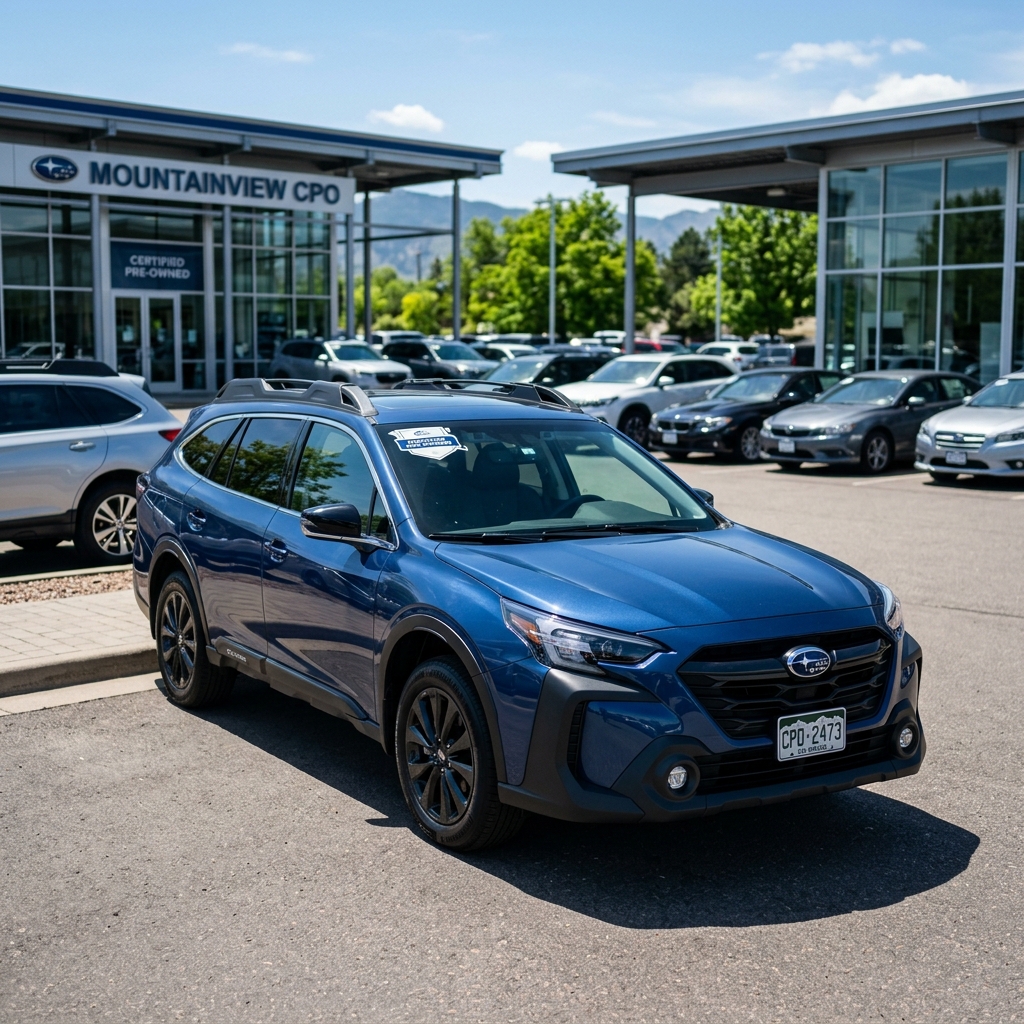
A Factory Certified Pre-Owned (CPO) car is worth the premium when the warranty is backed by the manufacturer, the coverage fits how long you will keep the car, and the dealer has not stretched the price far beyond what similar non-certified cars sell for. A subsidized financing rate can tip the math further in its favor. Here is how to tell a fair CPO deal from an overpriced one.
Quick answer
Bottom Line: A Factory Certified Pre-Owned (CPO) car costs more than a comparable non-certified used car, and the gap varies by brand, model and dealer. The premium is worth it if the manufacturer backs the warranty, and especially if it offers a promotional financing rate well below typical used-car rates, or if you are buying a complex luxury car where a single repair can exceed the premium. Measure the premium yourself: compare the CPO asking price with similar non-certified listings. Avturo helps by comparing the asking price with live asking prices of comparable listings, and if you attach the car's Carfax or AutoCheck report, it reads the report and points out where it conflicts with the listing.
What is the difference between CPO and Used?
Let us clear up the confusion right now because the terminology can be incredibly misleading. Dealerships know that buyers want safety and reliability, and they use the word "certified" very loosely to capitalize on that fear. Here is how the different categories actually break down.
- Standard Used Car: Depending on the state and the seller, these are sold "as-is" or with a short dealer warranty. A few states require dealers to give a limited warranty on many used cars (New York does, under General Business Law 198-b), but private sales almost never include one. If the transmission fails on your drive home from a private sale, the repair bill is usually your problem. You absolutely need to hire an independent mechanic to do a pre-purchase inspection before buying one of these.
- Factory CPO: This is the gold standard of the used car market. The car is inspected to the manufacturer's checklist at a franchised dealer, it has to meet the brand's age and mileage limits (commonly up to about 6 years old and 75,000 to 85,000 miles for mainstream brands, often tighter for luxury brands), and it includes a warranty backed by the actual manufacturer (such as Toyota, BMW, or Ford). If something covered breaks, any franchised dealer of that brand can do the repair.
- Dealer Certified: Watch out for this category. "Dealer Certified" is a marketing term with no standard meaning. The warranty, if any, is backed by the dealership itself or a third-party company, not the manufacturer. These contracts often have more exclusions, may limit where you can get repairs, and can cover far less than a factory CPO warranty. Read the contract before you pay extra for one.
CPO vs. Used vs. Dealer Certified: Side-by-Side
| Feature | Standard Used | Factory CPO | Dealer Certified |
|---|---|---|---|
| Warranty | None to a short dealer warranty (some states require one) | Manufacturer-backed; terms vary by brand | Dealer or third-party; often more exclusions |
| Inspection | None (buyer's responsibility) | 100 to 200 point factory inspection | Variable, no standard |
| Typical Premium | Baseline | Varies by brand, model and dealer | Varies; check what the contract covers |
| Age / Mileage Limit | None | Set by each brand, commonly up to about 6 years and 75K to 85K miles | None |
| Where to Service | Anywhere | Any franchised dealer of the brand | Often limited to specific shops |
| Subsidized Financing | Rarely | Sometimes (manufacturer promotional rates) | Rarely |
| Risk Level | High | Low | High |
How much more does a CPO car actually cost?
You are paying for peace of mind, and peace of mind is not free. There is no single "right" CPO premium: it varies by brand, model, region and dealer, and it moves with the market. The only reliable way to know what you are paying is to measure it for the car in front of you.
Find several similar non-certified listings (same model, close in year and mileage) and compare their asking prices with the CPO car's. The difference is roughly what you are paying for the certification. That premium is supposed to cover the multi-point inspection, any reconditioning the dealer did to meet the manufacturer's standard, and the cost of the CPO warranty itself.
The dealer sets the final CPO price, not the manufacturer, so part of that premium is dealer profit, and that part is negotiable. Ask what reconditioning was done, ask for the CPO inspection checklist, and decide what the extra coverage is worth to you. It also pays to understand the full breakdown of dealer fees before you sign anything.
Check Any Listing in About a Minute
Paste a Facebook Marketplace or dealer link. Avturo shows the red flags in the ad, the problems that model is known for, and what to ask the seller.
Try Avturo FreeWhen IS the CPO premium worth paying?
Despite the markup, there are clear scenarios where paying the CPO premium is a genuinely smart financial decision. Here are the three times you should seriously consider the certified option:
- You are buying a luxury or European vehicle. A turbocharger replacement on a BMW 5 Series or a transmission repair on a Mercedes-Benz C-Class can run into the thousands of dollars. When a single out-of-warranty repair could cost more than the entire CPO premium, the math is simple: pay for the warranty.
- The manufacturer offers subsidized financing. Brands such as Toyota, Honda and BMW sometimes run promotional APRs on CPO cars that are well below typical used-car rates. Experian's State of the Automotive Finance Market data put the average used-car loan rate at about 11% in the second quarter of 2026. If the CPO car qualifies for a promotional rate several points lower, the interest savings can offset much or all of the CPO premium, sometimes making the CPO car cheaper over the life of the loan.
- You plan to keep the car for 3+ years. The longer you own the car, the more value you extract from the extended warranty. If you keep vehicles for many years, a long CPO powertrain warranty (where the brand offers one) can cover major engine and transmission failures well past the original warranty. Check the end date: most CPO coverage is counted from the car's original in-service date, comprehensive coverage is often short, and powertrain coverage does not include parts like suspension or electronics.
Best CPO Programs in 2026: A Quick Brand Comparison
Not all CPO programs are created equal. Here is how some major manufacturers' programs compare on warranty length. Terms, tiers and eligibility change, so confirm the current details on the brand's CPO site or in the warranty booklet before you buy:
- Toyota CPO: Among the best in the industry. Toyota's standard Certified Used Vehicle coverage is a 12-month/12,000-mile comprehensive warranty plus a 7-year/100,000-mile powertrain warranty counted from the car's original in-service date (coverage can differ for older, higher-mileage certified cars). Lexus runs its own L/Certified program with separate terms. Combined with Toyota's strong reliability record, this is often the benchmark.
- BMW CPO: Adds 1 year of coverage with unlimited miles after the original 4-year/50,000-mile new-car warranty expires. BMW Financial Services sometimes runs promotional rates on CPO cars. Given how expensive BMW repairs can be, this extra year is worth a lot.
- Honda CPO: The HondaTrue Certified powertrain warranty runs 7 years/100,000 miles from the car's original in-service date. Non-powertrain coverage depends on the tier (HondaTrue Certified or HondaTrue Certified+) and on whether the car is still within its new-car warranty, so check the exact terms for the car you are looking at.
- Ford CPO: Ford Blue Advantage Gold Certified cars come with a 12-month/12,000-mile comprehensive warranty plus a 7-year/100,000-mile powertrain warranty from the original warranty start date. The lower Blue Certified tier has much shorter coverage. The value depends heavily on the specific model; it is more worthwhile on an F-150 with a turbocharged EcoBoost engine than on a base Escape.
- Hyundai / Kia CPO: On new cars, both brands give the original owner a 10-year/100,000-mile powertrain warranty, but later owners of a non-certified car get only 5 years/60,000 miles. Hyundai and Kia CPO programs restore 10-year/100,000-mile powertrain coverage (from the original in-service date), which is a real benefit when you are not the first owner. Check how much of that time and mileage is left.
When is the CPO premium NOT worth it?
We love warranties, but we hate bad deals. There are several scenarios where paying the CPO premium is a terrible financial decision. Here are the three times you should definitely skip the certified car:
- The warranty is third-party. As mentioned above, if it is not a genuine manufacturer-backed warranty, do not pay a factory-CPO premium for it. Third-party contracts vary widely, and many cover far less than they appear to.
- The base price is wildly inflated. Some dealers use the CPO label to justify a markup far beyond what the extra coverage is worth. If the gap between the CPO car and similar non-certified listings runs to several thousand dollars on an ordinary commuter car, you could buy a standard used car and put that money in a savings account for future repairs instead. Use the negotiation tactics in our guide to push back.
- It is a famously reliable model. If you are buying a used Toyota Corolla, Honda Civic, or Mazda 3 with a well-documented maintenance history, a large CPO premium may buy you little. These models have strong reliability records, so the chance of a major covered failure during the warranty period is comparatively low.
What do real repair costs look like?
To put numbers on the decision, here are Avturo's model-specific estimates of annual maintenance and likely repair costs for popular CPO candidates. They are estimates, not guarantees. If the expected annual cost is low, the CPO premium may not be worth it. If it is high, the warranty is more likely to pay for itself.
| Model | Typical years | Avturo cost-to-own (maint. + repairs / yr) |
|---|---|---|
| Toyota RAV4 | 2021 to 2023 | $700 to $1,100 |
| Honda CR-V | 2021 to 2023 | $700 to $1,100 |
| BMW 3 Series | 2021 to 2023 | $1,700 to $2,500 |
| Mercedes-Benz C-Class | 2020 to 2023 | $1,700 to $2,500 |
| Ford F-150 | 2020 to 2023 | $1,100 to $1,600 |
| Hyundai Tucson | 2022 to 2024 | $800 to $1,200 |
Figures are Avturo's own estimates for scheduled maintenance plus typical repairs only, at US independent-shop prices. They exclude insurance, fuel, financing, and depreciation, which vary too much per driver to be useful. They are estimates, not measurements, and no outside source has reviewed them; each range is adjusted for the example car's age and mileage (about 55,000 miles). Your real number depends on the individual car's condition and service history, so ask the seller for the records. If you attach a Carfax or AutoCheck report when you run a listing, Avturo reads it and compares it with the ad.
How CPO fits into the depreciation curve
One of the smartest reasons to buy CPO is that you are purchasing the car after the steepest part of the depreciation curve. Cars lose value fastest in their first few years, so a 2 to 3 year old car has already taken much of that hit, yet it still has most of its useful life ahead. The CPO warranty extends protection into the years when depreciation slows but mechanical wear increases, a financial sweet spot if the price is right.
How Avturo helps you spot CPO markups
Because CPO premiums vary from one dealer to the next, you should never blindly accept the sticker price. A history report like Carfax tells you about reported accidents and title events, but it will not tell you whether the asking price is out of line with similar cars. That is where Avturo helps.
Avturo is not a vehicle history report. It is an AI assistant that analyzes one car listing at a time. Here is what it can do for a CPO decision:
- Price Check Against Comparable Listings: Avturo compares the CPO asking price with live asking prices of comparable listings it finds online (same model, within two model years, similar mileage), nationally for the listing's country. When it can't find enough, the report says the price was not compared. These are asking prices, not sale prices, they are not adjusted for condition, and they can include both certified and non-certified cars, so treat the result as a guide to whether the price is out of line rather than an exact measure of the CPO premium.
- History Report Reading: A CPO inspection only looks at the car today, and Avturo has no access to service records. If you attach the car's Carfax or AutoCheck report as a PDF, Avturo reads it, highlights the service entries it shows, and points out where it contradicts the listing. Gaps in a car's records matter, as our guide to hidden maintenance gaps explains, so ask the dealer for whatever service records they have.
- Cost-to-Own Estimate: Should you pay for the CPO warranty? Avturo's report includes an estimated annual cost for maintenance and likely repairs for that model, with its source shown. If the expected repair costs over the years you would be covered are well below the CPO premium, that is a reason to negotiate the price down or skip the certified car.
Can you negotiate a CPO price?
Absolutely. Dealerships may suggest that CPO pricing is fixed by the manufacturer. It is not. The dealership sets the final price, and there is usually room to negotiate.
You can and should negotiate the price of a CPO vehicle just like you would any other used car. When you walk into the dealership with an Avturo report in hand, you can point to the asking prices of comparable listings and say, "Similar cars without the certification are listed for about $3,000 less. I am willing to pay a reasonable premium for the CPO warranty, but not that much." For the complete playbook on dealer negotiations, read our complete buyer's playbook.
The Final Verdict
A Factory CPO car can be a fantastic purchase, especially if you are buying a complex luxury vehicle where repairs are incredibly expensive. But it is only a good deal if the price is right. Never assume that a certified badge means you are getting a fair shake. Always do your research, verify the warranty is backed by the manufacturer, and compare the price with similar listings before you sign.
If you are still early in your car-buying journey, start with our complete used-car buyer's playbook for a step-by-step framework that covers everything from setting your budget to closing the deal.