
You arrive to test drive a used car. The instrument cluster shows no warning lights, the car starts right up, and the seller promises that "it runs like a clock." But three days after you hand over cash, the amber Check Engine light suddenly illuminates on your dashboard. When you scan the computer, you find an expensive catalytic converter code that the seller erased right before you arrived.
Quick answer
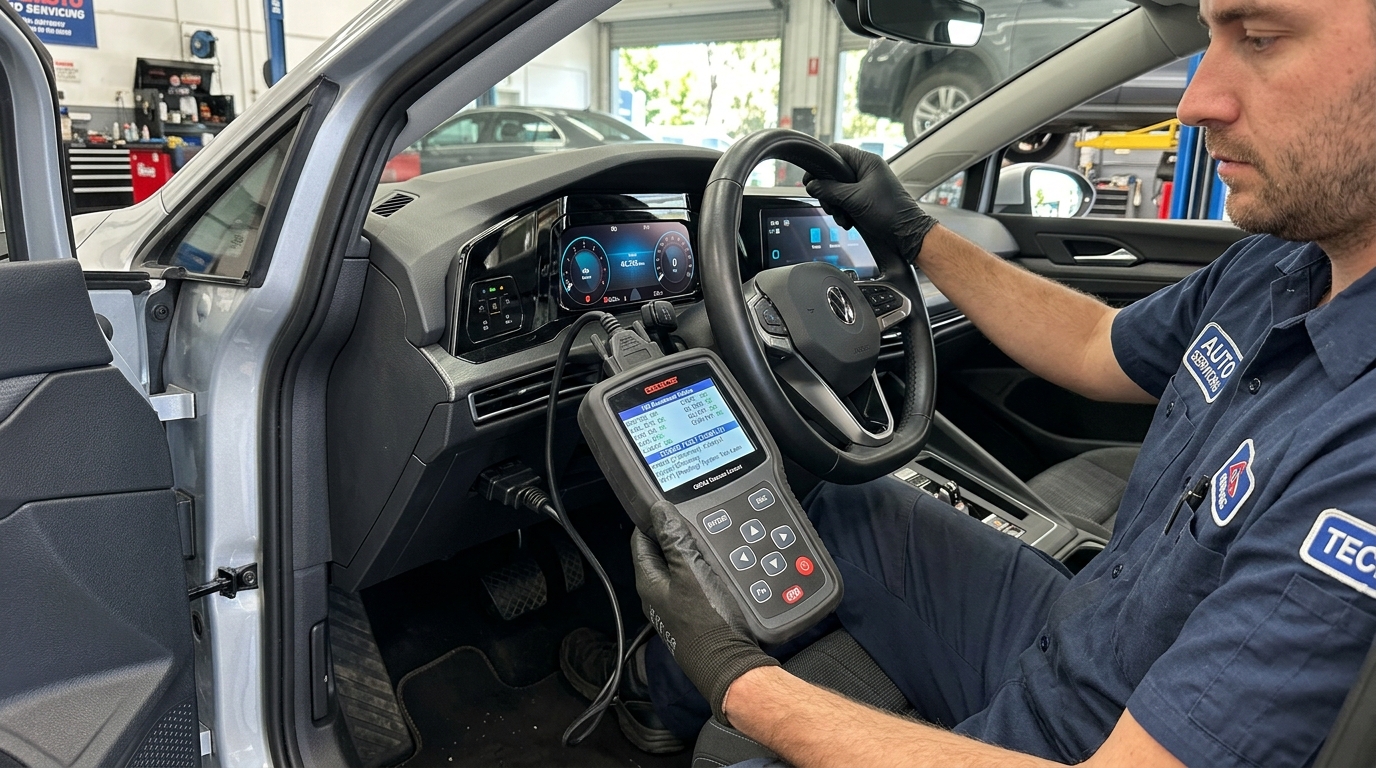
Clearing a Check Engine light with an OBD2 scanner also resets the car's internal I/M Readiness Monitors to "Not Ready." By plugging any inexpensive $20 OBD2 scanner into the diagnostic port under the driver's dash, you can check whether all emissions systems (Catalytic Converter, EVAP, O2 Sensors) show "Ready." If multiple monitors read "Not Ready" or "Incomplete" on a warm car, the seller recently wiped the computer codes to conceal an active mechanical failure.
How the Cleared Code Scam Works
Modern vehicle Engine Control Units (ECUs) constantly run self-diagnostic checks on critical engine, transmission, and emissions components. When a component fails or drifts out of acceptable tolerances (such as an engine misfire, a failing oxygen sensor, or a deteriorating catalytic converter), the computer illuminates the Check Engine light and stores a Diagnostic Trouble Code (DTC).
Unscrupulous private sellers and curbstoners know that an illuminated warning light kills resale value and scares away buyers. Using a pocket OBD2 code reader or disconnecting the car's 12V battery terminal for 10 minutes, they clear all stored codes.
The dashboard light turns off immediately. However, the underlying mechanical defect is still there. The computer needs specific driving conditions (known as a Drive Cycle) consisting of cold starts, steady 55 mph highway cruising, and deceleration to re-test those systems. For complex monitors like the evaporative emissions (EVAP) system and catalytic converter efficiency, it can take 50 to 100 miles of driving before the light returns. By that time, you have already paid and signed the as-is bill of sale.
Understanding I/M Readiness Monitors
Every OBD2 vehicle manufactured since 1996 features Inspection/Maintenance (I/M) Readiness Monitors. These are internal software flags that record whether each individual emissions sub-system has completed its self-test routines.
| Monitor Name | What It Monitors | Common Failure / Repair Cost |
|---|---|---|
| CAT (Catalytic Converter) | Exhaust emissions scrubbing efficiency. | $1,200 to $2,800 for OEM replacement. |
| EVAP (Evaporative System) | Fuel vapor leak detection and purge valves. | $250 to $700 for charcoal canisters or leak detection pumps. |
| O2S (Oxygen Sensor) | Air/fuel mixture upstream and downstream sensors. | $200 to $500 per sensor. |
| EGR / VVT | Exhaust gas recirculation and variable valve timing solenoids. | $350 to $1,100 for actuators or solenoids. |
| MIS (Misfire Monitor) | Cylinder firing cadence and spark efficiency. | $150 to $900 for ignition coils, plugs, or injectors. |
Continuous monitors (such as Misfire, Fuel System, and Comprehensive Components) run constantly. Non-continuous monitors (Catalyst, Evap, O2 Sensor) only run during specific drive cycle parameters.
How to Check Readiness in 60 Seconds with a Scanner
You do not need to be a professional mechanic to catch this scam. Buy a simple OBD2 pocket scanner (Bluetooth dongles like Veepeak or wired hand scanners from Ancel cost under $25 on Amazon). Follow this quick protocol when viewing any used car:
- Plug Into the Port: Locate the 16-pin OBD2 port, typically located underneath the steering wheel dashboard panel or near the driver's left knee.
- Turn Ignition to ON (Engine Running): Start the car and let the scanner link to the ECU.
- Open the I/M Readiness Menu: Look for the "I/M Readiness" or "Smog Check" screen. Most scanners display this with simple green, yellow, or red LED icons.
- Inspect the Status: A healthy car that has been driven regularly will show "Ready" or "Complete" across all monitors (some states allow one monitor, usually EVAP, to be incomplete).
- Check for "Not Ready" Statuses: If 2, 3, or more monitors show "Not Ready" or "INC", the codes were recently cleared. The seller either disconnected the battery or cleared fault codes shortly before your arrival.
- Check Pending Codes: Navigate to the "Read Codes" screen and look specifically under "Pending Codes." Pending codes are faults that the computer has detected during your test drive but hasn't illuminated the dashboard bulb for yet.
What to Say When You Find Incomplete Monitors
If your scanner shows multiple monitors in "Not Ready" status, do not panic, but do not complete the purchase either. Confront the situation calmly with this script:
If the seller genuinely just installed a new battery, they will understand and have no issue letting the monitors set. If they cleared a blown catalytic converter or secondary air injection failure, they will often get agitated or claim another buyer is on the way. That is your cue to walk away.
Analyze Any Listing in Seconds
Paste a Facebook Marketplace or dealer link. Avturo flags hidden issues and suggests what to ask.
Try Avturo FreeTypical Cost of Repairs Caught by OBD2 Checks
Wiping trouble codes is common on vehicles between 70,000 and 130,000 miles, exactly when emissions components and oxygen sensors reach the end of their operational lifespan:
| Model | Typical years | Avturo cost-to-own (maint. + repairs / yr) |
|---|---|---|
| Nissan Rogue | compact crossover | $800 to $1,200 |
| Chevrolet Equinox | compact SUV | $700 to $1,100 |
| Ford Escape | compact SUV | $700 to $1,100 |
| Toyota Prius | hybrid hatchback | $600 to $1,000 |
Figures are Avturo's model-specific estimates for scheduled maintenance plus likely out-of-warranty repairs only. They exclude insurance, fuel, financing, and depreciation, which vary too much per driver to be useful. Ranges are anchored to Edmunds True Cost to Own and RepairPal data, then adjusted for a high-mileage budget example (about 90,000 miles). Your real number depends on the individual car's service history, which is exactly what Avturo checks when you run a listing.
The Simple "Bulb Check" Visual Test
Even if you do not have an OBD2 scanner with you, there is an older physical fraud you must test: the bulb removal scam. Shady sellers sometimes disassemble the instrument cluster and put black electrical tape over the Check Engine LED or solder it to the oil pressure light so it never lights up.
To verify:
- Insert the key and turn the ignition switch to the ON (Position II) position without starting the engine.
- All instrument warning lights (Check Engine, Oil, Battery, ABS, Airbag) must illuminate solid for 3 to 5 seconds. This is the built-in system bulb check.
- If the Check Engine bulb does not illuminate during the bulb check, the bulb has been removed or disabled. Do not buy the car under any circumstances.
Summary
A clean dashboard without a glowing Check Engine light does not guarantee a healthy car. Disconnecting a battery or tapping "Clear Codes" takes thirty seconds, but resetting internal I/M readiness monitors takes dozens of miles of varied driving. Carry an inexpensive OBD2 scanner to every viewing, verify that readiness monitors are complete, check for pending codes, and protect yourself from inheriting someone else's expensive repair bills.